
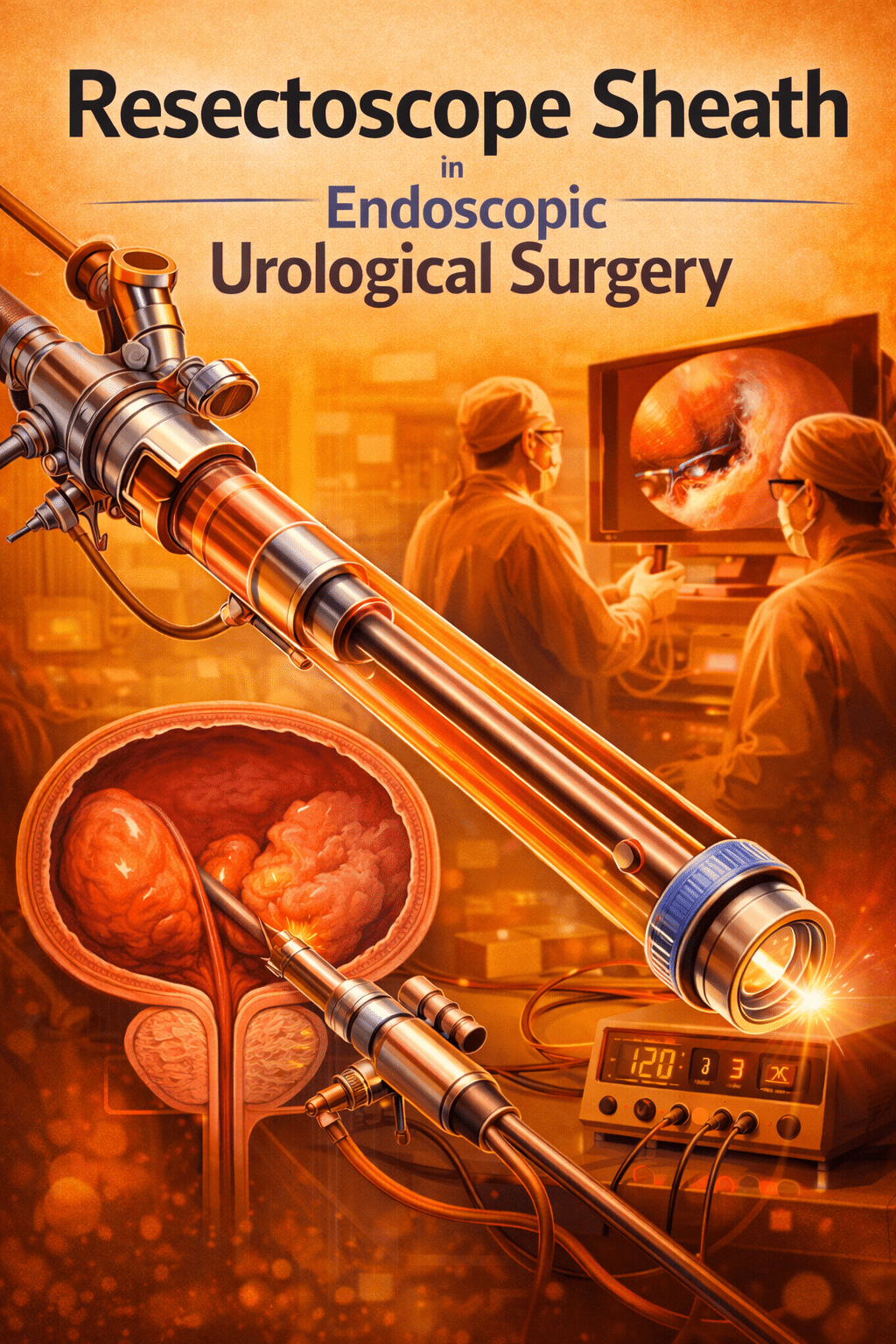
In endoscopic urological surgery, the efficiency and safety of the procedure depend not only on energy systems and resection tools, but also on the components that support stability, visibility, and fluid control.
One of these essential components is the resectoscope sheath, a critical element in transurethral procedures such as prostate and bladder resections.
Designed to guide instruments and manage irrigation flow, the resectoscope sheath plays a central role in maintaining a clear surgical field while protecting surrounding tissue. Its design directly impacts visibility, pressure control, and overall procedural safety.
As surgical techniques continue to evolve toward minimally invasive and bipolar technologies, understanding the function and design of the resectoscope sheath has become increasingly important for surgeons and healthcare institutions alike.
This article explores the role of the resectoscope sheath in endoscopic surgery, its different types, clinical benefits, and how it integrates with modern bipolar resection systems.
Explore Lamidey-Noury solutions for urological surgery!
Article Index
- What Is a Resectoscope Sheath?
- Role of the Sheath in Endoscopic Surgery
- Types of Resectoscope Sheaths
- Continuous Flow vs Single Flow
- Importance for Visibility and Safety
- Compatibility With Bipolar Systems
- Clinical Benefits for Surgeons
- Benefits for Hospitals
- Maintenance and Handling Considerations
- Future Developments in Resectoscope Sheath Design
1. What Is a Resectoscope Sheath
A resectoscope sheath is the outer tube of the resectoscope used during endoscopic urological procedures. It serves as a guiding channel for surgical instruments while enabling continuous irrigation throughout the procedure.
Positioned within the urethra, the sheath plays a critical role in maintaining stability, protecting surrounding tissue, and supporting safe instrument navigation.
Unlike internal working elements such as loops or electrodes, the sheath does not deliver energy directly. Instead, it provides a controlled pathway for both instruments and irrigation fluids. This design ensures consistent visualization and minimizes trauma during insertion and manipulation.
In procedures such as transurethral resection of the prostate (TURP) and bladder tumor resection (TURBT), the resectoscope sheath is essential for procedural efficiency and patient safety. Its dimensions, flow configuration, and compatibility directly influence surgical performance.
As endoscopic surgery continues to advance, the resectoscope sheath remains a foundational component that supports precision, visibility, and procedural control.
Explore Lamidey-Noury urology solutions!
2. Role of the Sheath in Endoscopic Surgery
In endoscopic surgery, the resectoscope sheath functions as the structural backbone of the instrument system. It stabilizes the resectoscope within the urethra and provides a consistent working channel for surgical tools and optical components.
One of its primary roles is facilitating irrigation. By allowing controlled inflow and outflow of fluid, the sheath maintains a clear surgical field and prevents excessive pressure buildup.
This is particularly important in long or complex procedures where visualization directly impacts safety and outcomes.
Additionally, the sheath protects the urethral wall from repeated instrument movement. Smooth insertion and stable positioning reduce mechanical trauma and postoperative complications.
Through these functions, the resectoscope sheath supports precise tissue interaction and enhances the overall reliability of endoscopic procedures.
Discover endoscopic surgical technologies!
3. What are the types of Resectoscope Sheaths?
Resectoscope sheaths are available in different configurations to meet varying procedural needs. The most common distinctions are based on flow design, diameter, and compatibility with surgical systems.
Sheaths vary in size to accommodate different patient anatomies and procedural requirements. Selecting the appropriate diameter helps balance ease of insertion with optimal irrigation flow.
Material quality and surface finishing also differ between sheath types. High-quality materials improve durability, reduce friction, and support smooth instrument handling during surgery.
Choosing the right sheath configuration is essential for optimizing surgical performance and ensuring compatibility with resection systems and instruments.
4. Continuous Flow vs Single Flow
One of the most important distinctions in resectoscope sheaths is between continuous-flow and single-flow designs.
Single-flow sheaths allow irrigation fluid to enter the surgical field but rely on passive outflow. While effective in shorter procedures, they may limit visibility during prolonged resections.
Continuous-flow sheaths, on the other hand, allow simultaneous inflow and outflow of irrigation fluid. This design maintains stable pressure and consistently clear visibility, making it the preferred option for longer and more complex procedures.
By improving visualization and reducing pressure fluctuations, continuous-flow sheaths enhance surgical control and patient safety.
5. Importance for Visibility and Safety
Clear visualization is critical in endoscopic surgery, and the resectoscope sheath plays a central role in achieving it. Efficient irrigation flow prevents blood and tissue debris from obscuring the surgical field.
Stable sheath positioning also minimizes unintended movement, reducing the risk of tissue injury. This stability allows surgeons to focus on precise resection rather than managing visibility issues.
From a safety perspective, controlled fluid dynamics help prevent excessive intravesical pressure, reducing postoperative complications.
Together, these factors make the resectoscope sheath essential for safe and effective endoscopic procedures.
6. Compatibility With Bipolar Systems
Modern resectoscope sheaths are designed to be fully compatible with bipolar resection systems. This compatibility ensures safe energy confinement and allows the use of saline irrigation.
When integrated with bipolar electrosurgery generators and bipolar loops, the sheath supports precise energy delivery and optimized tissue interaction.
System compatibility simplifies setup and reduces variability during surgery, contributing to predictable outcomes and efficient workflows.
Explore bipolar technology solutions!
7. Clinical Benefits for Surgeons
For surgeons, a well-designed resectoscope sheath improves procedural confidence and efficiency. Smooth insertion, stable positioning, and consistent irrigation contribute to better control throughout the operation.
Improved visibility and reduced interruptions allow surgeons to work more efficiently and with greater precision. This enhances overall surgical performance and reduces fatigue during long procedures.
8. What are the Benefits for Hospitals?
From an institutional perspective, reliable resectoscope sheaths support standardized workflows and reduce complication rates. Improved efficiency contributes to shorter operating times and optimized resource utilization.
Durable designs and system compatibility also simplify inventory management and staff training, making them a cost-effective choice for hospitals.
Discover healthcare solutions
9. Maintenance and Handling Considerations
Proper maintenance of resectoscope sheaths is essential for long-term performance and safety. Regular inspection, correct cleaning procedures, and adherence to sterilization protocols help preserve functionality.
High-quality materials improve resistance to wear and ensure consistent performance across repeated uses.
10. Future Developments in Resectoscope Sheath Design
Future innovations in resectoscope sheath design focus on improved ergonomics, enhanced flow efficiency, and better system integration. Advances in materials and manufacturing techniques aim to further improve durability and safety.
As endoscopic surgery continues to evolve, resectoscope sheaths will remain a key component in advancing precision and patient care.