
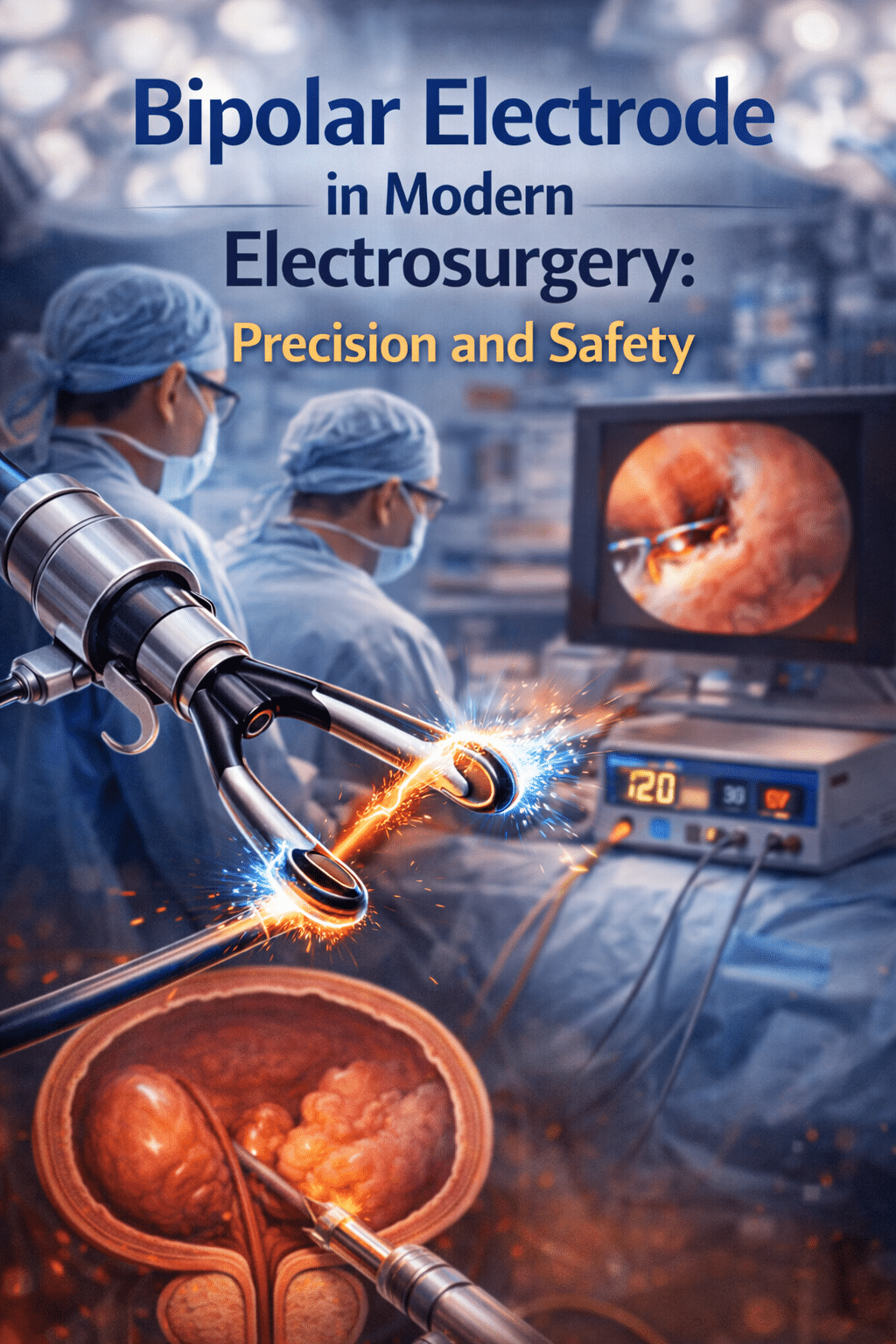
In modern electrosurgical procedures, precise energy delivery and tissue control are essential for achieving safe and predictable outcomes. Among the key components that enable this level of control is the bipolar electrode, a fundamental element in bipolar electrosurgery systems.
Designed to confine electrical current to the surgical site, bipolar electrodes support accurate tissue interaction while reducing systemic risks.
As surgical techniques increasingly rely on minimally invasive and energy-based technologies, understanding how bipolar electrodes function and integrate with electrosurgery generators and resection systems has become critical for surgeons and healthcare institutions.
This article explores the role of bipolar electrodes, their clinical advantages, and their importance in modern surgical practice, particularly within urology.
Explore Lamidey-Noury electrosurgical solutions!
Article Index
-
What Is a Bipolar Electrode?
-
How Bipolar Electrodes Work?
-
Bipolar vs Monopolar Electrodes
-
Role of Bipolar Electrodes in Urology
-
Precision and Tissue Interaction
-
Safety Advantages of Bipolar Electrodes
-
Compatibility With Electrosurgery Generators
-
Clinical Benefits for Surgeons
-
Benefits for Hospitals and OR Efficiency
-
Future Developments in Bipolar Electrode Technology
1. What Is a Bipolar Electrode?
A bipolar electrode is a surgical instrument designed to deliver electrical energy between two closely spaced poles located at the operative site. Unlike monopolar electrodes, bipolar electrodes confine the electrical circuit to the tissue being treated, eliminating the need for a return electrode elsewhere on the patient’s body.
This localized energy delivery enhances surgical control and reduces unintended tissue interaction. Bipolar electrodes are commonly used in cutting, coagulation, and resection procedures, particularly in endoscopic and minimally invasive surgery.
In urology, bipolar electrodes play a central role in procedures such as prostate and bladder resections. Their design supports precise tissue handling while maintaining effective hemostasis, making them a reliable choice in modern surgical environments.
Explore Lamidey-Noury urology expertise!
2. How Bipolar Electrodes Work?
Bipolar electrodes operate by transmitting high-frequency electrical current between two electrodes positioned within the surgical instrument. When activated, the current passes directly through the targeted tissue, generating controlled thermal effects that enable cutting or coagulation.
This closed electrical circuit minimizes energy dispersion and reduces thermal spread to surrounding structures. Surgeons can adjust power settings through the electrosurgery generator to match tissue type and procedural requirements, ensuring consistent and predictable performance.
The confined energy pathway allows bipolar electrodes to function effectively with saline irrigation, further enhancing safety and procedural stability.
Discover electrosurgery generator technology!
3. Bipolar vs Monopolar Electrodes
The key distinction between bipolar and monopolar electrodes lies in how electrical current is delivered. In monopolar systems, current travels through the patient’s body to a return electrode, requiring careful monitoring and non-conductive irrigation fluids.
Bipolar electrodes, by contrast, restrict current flow to the surgical site. This design improves safety, reduces systemic risks, and allows the use of saline irrigation. As a result, bipolar electrodes offer improved hemostasis and enhanced control during longer or more complex procedures.
Rather than replacing monopolar technology entirely, bipolar electrodes represent an advancement that aligns with modern safety and efficiency standards.
Learn more about bipolar technology!
4. Role of Bipolar Electrodes in Urology
In urology, bipolar electrodes are widely used in transurethral procedures involving the prostate and bladder. These procedures require precise tissue resection and reliable bleeding control, both of which are supported by bipolar energy delivery.
By enabling simultaneous cutting and coagulation, bipolar electrodes help maintain a clear surgical field and reduce operative time. Their compatibility with saline irrigation further enhances safety during endoscopic urological surgery.
As minimally invasive techniques continue to advance, bipolar electrodes remain essential tools in achieving consistent and high-quality urological outcomes.
Explore urological surgical solutions!
5. Precision and Tissue Interaction
Precision is a defining advantage of bipolar electrode technology. The controlled flow of electrical energy allows surgeons to perform accurate tissue manipulation with minimal collateral damage.
Reduced thermal spread preserves surrounding structures and supports faster healing. Improved tissue interaction also enhances the quality of resected specimens, contributing to accurate pathological evaluation.
This level of precision is particularly valuable in delicate urological procedures where tissue preservation is critical.
Discover precision-driven surgical instruments!
6. Safety Advantages of Bipolar Electrodes
Safety is a major benefit of bipolar electrodes. By confining electrical current to the surgical site, these electrodes minimize systemic exposure and reduce the risk of unintended burns or electrical complications.
The ability to use saline irrigation further improves patient safety and procedural stability. When combined with advanced electrosurgery generators, bipolar electrodes benefit from real-time energy monitoring and automatic power regulation.
These features make bipolar electrodes a trusted choice in modern electrosurgical practice.
7. Compatibility With Electrosurgery Generators
Bipolar electrodes are specifically engineered to operate in full coordination with electrosurgery generators that support bipolar energy modes. This technical compatibility is a key element in achieving stable energy delivery and predictable tissue interaction during urological procedures.
When the electrode and generator function as an integrated unit, the electrical current remains confined to the tissue located between the two poles of the loop, which increases precision and reduces the risk of unintended thermal spread.
Modern generators are designed with advanced feedback mechanisms that continuously monitor tissue impedance and automatically adjust power output. This dynamic regulation ensures smooth cutting performance and reliable coagulation without excessive charring or sticking of tissue to the loop.
Integrated bipolar systems also simplify the preparation process inside the operating room. Surgeons and nurses can connect the instruments quickly, select predefined programs, and begin the procedure with minimal technical adjustments.
This standardization reduces variability between cases and promotes consistent surgical quality. Furthermore, the compatibility between devices improves overall safety, as saline irrigation can be used instead of nonconductive fluids, eliminating complications related to electrolyte imbalance.
The predictable interaction between generator and electrode allows surgeons to maintain clear visibility and controlled resection even in challenging anatomical conditions. For these reasons, seamless compatibility is considered a fundamental requirement for high performance endoscopic surgery.
8. Clinical Benefits for Surgeons
Bipolar electrodes provide a wide range of clinical advantages that directly support the daily practice of urological surgeons. One of the most important benefits is the enhanced level of control over both cutting and coagulation phases.
The localized current pathway enables precise tissue removal while maintaining effective hemostasis, which significantly improves the visual field during endoscopic procedures.
Clear visibility allows the surgeon to identify anatomical landmarks more easily and to perform accurate resection with greater confidence. This level of control becomes particularly valuable during complex operations or when treating highly vascular tissues.
Another major advantage is the reduction of operative stress. Predictable tissue response and stable energy delivery mean that surgeons can rely on consistent instrument behavior throughout long procedures.
The risk of unexpected bleeding or tissue damage is minimized, leading to smoother workflow and fewer interruptions. Bipolar technology also shortens the learning curve for younger surgeons, as the handling characteristics are intuitive and forgiving.
Over time, these factors contribute to improved surgical performance and better clinical outcomes for patients.
Reliable hemostasis reduces the need for additional coagulation steps and decreases postoperative complications. Surgeons benefit from shorter operative times and greater efficiency, which allows them to focus on strategic decision making rather than technical difficulties.
The combination of safety, precision, and ease of use explains why bipolar electrodes have become a preferred tool in modern urology.
9. Benefits for Hospitals and OR Efficiency
From the perspective of hospitals and healthcare institutions, bipolar electrodes represent an important contribution to operating room efficiency and resource optimization. Procedures performed with bipolar technology are generally associated with shorter operative duration, reduced blood loss, and lower complication rates.
These clinical improvements translate into faster patient recovery and decreased length of hospital stay, which directly impact institutional costs and bed management. Efficient use of operating rooms allows hospitals to treat a higher number of patients without compromising quality of care.
Standardized bipolar platforms also simplify equipment management. Because the systems are compatible with a wide range of generators and accessories, hospitals can reduce the diversity of devices in their inventory.
This uniformity facilitates maintenance, sterilization, and staff training. Nurses and technicians become familiar with a single workflow, which minimizes preparation errors and increases procedural reliability.
In addition, the use of saline irrigation and controlled energy delivery lowers the risk of adverse events, decreasing the financial burden related to complications or readmissions.
Investment in bipolar technology therefore provides both clinical and economic value. Hospitals gain a modern solution that supports high quality surgery while controlling operational expenses.
The ability to deliver safe and efficient procedures strengthens institutional reputation and patient satisfaction, making bipolar systems a practical and strategic choice for contemporary healthcare facilities.
10. Future Developments in Bipolar Electrode Technology
The field of bipolar electrode technology continues to evolve in response to the growing demands of minimally invasive surgery. Future developments are focused on the creation of improved materials that offer greater durability, better conductivity, and enhanced resistance to wear.
Engineers are working on refined loop geometries that optimize energy distribution and allow even more delicate tissue manipulation. These innovations aim to provide surgeons with instruments that deliver higher precision while maintaining maximum safety for patients.
Another important direction is the integration of bipolar electrodes with smart electrosurgical platforms. Upcoming generators are expected to include advanced artificial intelligence algorithms capable of analyzing tissue characteristics in real time.
Such systems will automatically select the most appropriate power settings and adapt to changing surgical conditions. This level of automation will reduce dependence on manual adjustments and further standardize clinical results across different users and institutions.
As urological surgery moves toward less invasive and more patient centered approaches, bipolar electrodes will remain essential components of the surgical armamentarium.
Their ability to combine effective cutting, reliable coagulation, and excellent safety profile ensures a central role in future therapeutic strategies. Continuous research and collaboration between clinicians and manufacturers will drive the next generation of devices and open new possibilities for energy based surgery.