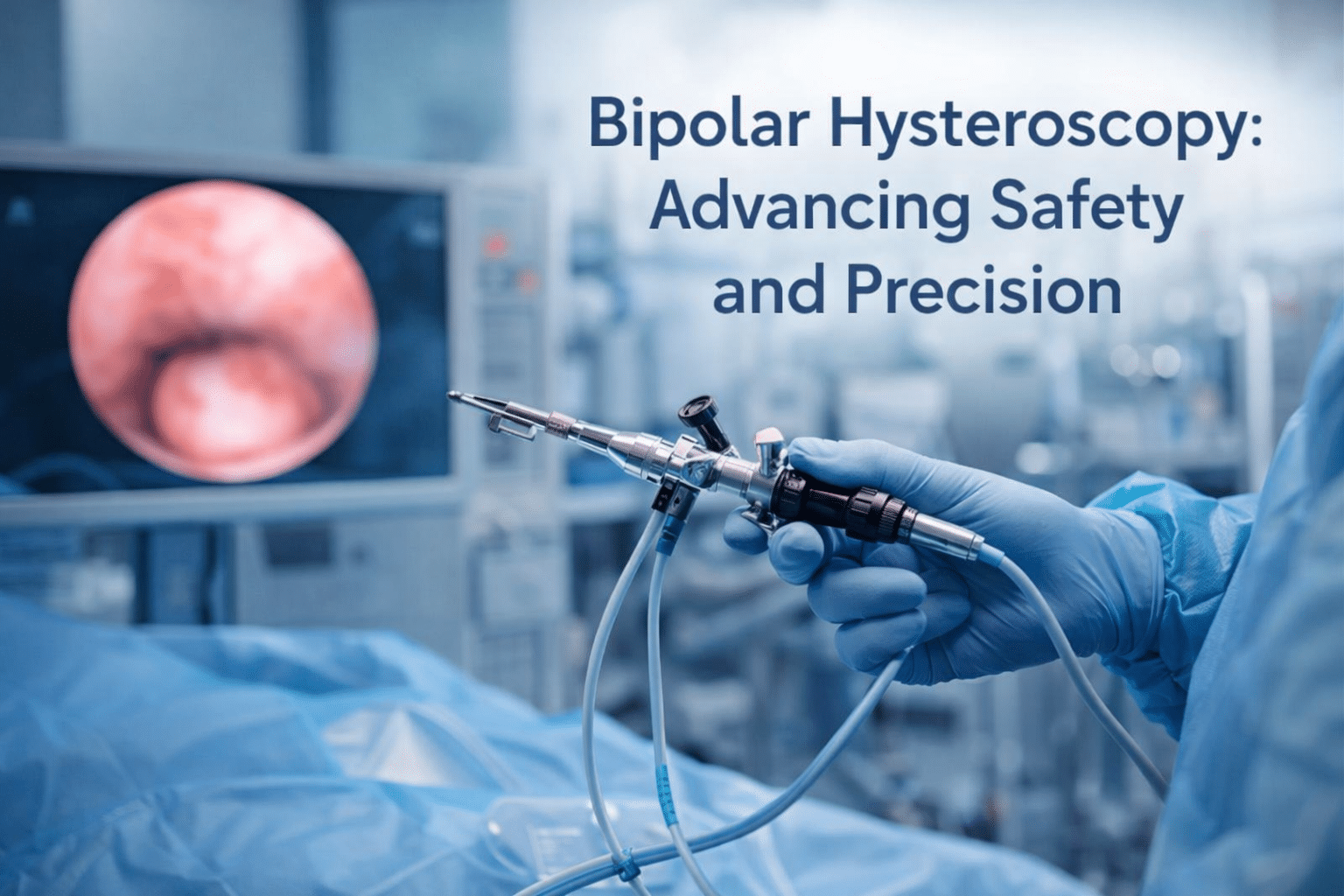
Unlike traditional monopolar systems, bipolar hysteroscopy allows the use of saline as a distension medium, which enhances safety and reduces systemic complications.
The localized electrical current pathway between two electrodes provides superior precision while minimizing collateral thermal damage. As outpatient and minimally invasive gynecologic procedures continue to expand globally, bipolar hysteroscopy has become a preferred technique due to its improved safety profile and predictable clinical outcomes.
Its adaptability to various intrauterine interventions underscores its importance in modern operative hysteroscopy.
Explore Lamidey-Noury solutions for urological surgery
Index
1- Understanding the Principles of Bipolar Energy
2- Why Bipolar Hysteroscopy Uses Saline?
3- Bipolar vs Monopolar Hysteroscopy
4- Clinical Applications of Bipolar Hysteroscopy
5- Role in Endometrial Resection
6- Use in Submucosal Fibroid Management
7- Advantages in Outpatient Settings
8- Safety Profile and Fluid Management
9- Technological Integration with Modern Generators
10- Future Perspectives of Bipolar Hysteroscopy
11- FAQ Section
1. Understanding the Principles of Bipolar Energy
At the core of bipolar hysteroscopy lies bipolar energy technology. In this system, electrical current flows exclusively between two electrodes located at the tip of the resectoscope or surgical instrument.
This closed circuit ensures that energy remains confined to the targeted tissue within the uterine cavity. Unlike monopolar systems, which require a return electrode pad and allow current to travel through the patient’s body, bipolar technology significantly reduces the risk of unintended electrical injury.
The precision of energy delivery allows surgeons to coagulate and resect tissue with minimal thermal spread. This localized control is especially important in delicate intrauterine procedures where preservation of surrounding endometrial tissue is critical.
Bipolar hysteroscopy leverages this controlled energy pathway to enhance both surgical safety and effectiveness.
Learn more about: Resectoscope Sheath in Endoscopic Urological Surgery
2. Why Bipolar Hysteroscopy Uses Saline?
One of the defining advantages of bipolar hysteroscopy is its compatibility with normal saline as the distension and irrigation medium. Saline is isotonic and physiologically compatible with plasma, reducing the risk of electrolyte imbalance during intrauterine procedures.
In contrast, monopolar hysteroscopy requires non-conductive fluids such as glycine or sorbitol, which carry a risk of hyponatremia and fluid overload. Because bipolar energy is confined locally between electrodes, the conductivity of saline does not compromise safety.
This innovation has dramatically improved patient safety standards in hysteroscopic surgery. The ability to use saline simplifies fluid management protocols and reduces systemic complications. As a result, bipolar hysteroscopy is widely regarded as a safer and more efficient approach to operative hysteroscopy.
3. Bipolar vs Monopolar Hysteroscopy
When comparing bipolar hysteroscopy to monopolar techniques, several clinical differences become apparent.
Monopolar systems require non-conductive irrigation fluids and a grounding pad, increasing the complexity of fluid management and potential risk of electrolyte imbalance. Bipolar hysteroscopy, by contrast, operates safely in saline and eliminates the need for a return electrode pad.
This reduces systemic electrical exposure and enhances patient safety. Additionally, bipolar systems provide improved thermal control and more predictable tissue interaction.
The reduced risk of fluid absorption syndrome has led many institutions to transition from monopolar to bipolar platforms. While both techniques can achieve effective intrauterine resection, bipolar hysteroscopy offers a superior safety profile and operational simplicity, making it increasingly favored in modern gynecologic practice.
Gain deeper insight into: Bipolar Loop in Urological Surgery: Advanced Performance
4. Clinical Applications of Bipolar Hysteroscopy
Bipolar hysteroscopy is widely used for a range of intrauterine procedures. These include the removal of endometrial polyps, treatment of abnormal uterine bleeding, septum resection, and management of retained products of conception.
The precision of bipolar energy allows targeted tissue removal while minimizing trauma to healthy endometrium. Surgeons benefit from reliable hemostasis and improved visualization due to reduced bleeding.
The controlled energy delivery supports safe and efficient operative workflows. As minimally invasive gynecologic surgery becomes more prevalent, bipolar hysteroscopy continues to demonstrate strong clinical value.
Its adaptability across diagnostic and therapeutic procedures highlights its central role in advancing intrauterine surgical standards.
5. Role in Endometrial Resection
In cases of abnormal uterine bleeding unresponsive to medical therapy, bipolar hysteroscopy is frequently used for endometrial resection. The technique enables controlled removal of endometrial tissue while preserving the underlying myometrium.
Bipolar energy allows uniform coagulation and resection, reducing postoperative complications. The use of saline irrigation enhances visualization and improves procedural control.
Compared to monopolar systems, bipolar hysteroscopy reduces the risk of electrolyte imbalance during longer procedures. This safety advantage is particularly relevant in patients with comorbidities.
The precision and predictability of bipolar energy make it a valuable tool in managing benign uterine conditions requiring surgical intervention.
6. Use in Submucosal Fibroid Management
Bipolar hysteroscopy plays a critical role in the treatment of submucosal fibroids. The ability to perform controlled resection within the uterine cavity is essential for preserving fertility and improving patient outcomes.
Bipolar systems provide effective cutting and coagulation while minimizing thermal spread to surrounding tissue. Saline irrigation enhances safety during prolonged resections. The controlled energy delivery allows gradual removal of fibroid tissue, reducing intraoperative bleeding and improving visualization.
As fertility-preserving surgical approaches gain importance, bipolar hysteroscopy supports safe and effective fibroid management with minimal invasiveness.
7. Advantages in Outpatient Settings
The enhanced safety profile of bipolar hysteroscopy has contributed to the growth of outpatient gynecologic procedures. Reduced risk of fluid imbalance and improved hemostasis support same-day discharge in many cases.
Patients benefit from shorter recovery times and reduced hospital stays. Surgeons appreciate the operational efficiency and simplified fluid management. The compatibility with saline irrigation simplifies setup and reduces reliance on specialized non-conductive fluids.
These factors collectively enhance cost-effectiveness and patient satisfaction. Bipolar hysteroscopy aligns with healthcare systems’ increasing focus on minimally invasive, ambulatory care models.
8. Safety Profile and Fluid Management
Although bipolar hysteroscopy significantly improves safety, proper fluid monitoring remains essential. Continuous assessment of inflow and outflow volumes prevents excessive fluid absorption.
While saline reduces electrolyte risks, fluid overload remains a concern if monitoring protocols are not followed. Advanced systems often integrate fluid management technologies to maintain safe intrauterine pressure levels.
Surgeon training and adherence to standardized guidelines are critical. By combining technological innovation with disciplined clinical practice, bipolar hysteroscopy ensures high safety standards in intrauterine surgery.
9. Technological Integration with Modern Generators
Modern bipolar hysteroscopy systems are integrated with advanced energy generators that provide precise power modulation. These generators incorporate impedance feedback mechanisms that adjust output based on tissue resistance.
This intelligent modulation enhances control and prevents overheating. The integration of advanced generators with bipolar instruments supports consistent and predictable performance.
As surgical platforms become more sophisticated, bipolar hysteroscopy continues to benefit from technological refinement that enhances both safety and efficiency.
10. Future Perspectives of Bipolar Hysteroscopy
The future of bipolar hysteroscopy lies in continued innovation in electrode design, energy modulation, and visualization systems. Plasma-assisted bipolar platforms may further refine tissue interaction and improve precision.
Enhanced imaging technologies could support more accurate intrauterine mapping. As patient safety standards continue to rise, bipolar hysteroscopy remains aligned with evolving clinical expectations.
Its combination of safety, precision, and compatibility with minimally invasive approaches ensures its sustained relevance in modern gynecologic surgery.